

UK Buyers: Resale Checks in Spain, Order, Who Issues, Avoid 3% Trap
· 16 min read

Do not sign a reservation contract or hand over a deposit on a Spanish resale property until an independent lawyer has completed full due diligence. That means a fresh Nota Simple, a community debt certificate, proof of licences, and confirmation of the seller’s tax status. If any of these three documents are missing, or dated more than 30 days before your planned completion, pause the purchase until they arrive.
TL;DR:
- Conduct a full due diligence process with an independent lawyer before signing a reservation contract or paying a deposit, including requesting a recent Nota Simple and debt certificate issued within the last 30 days.
- Check for any outstanding community charges, municipal taxes, or legal encumbrances such as mortgages, embargoes, or litigation annotations, especially if documents are older than a month.
- Verify that essential licenses like the first occupation licence and urban planning certificates are current and match the property’s actual state, particularly in coastal areas where building restrictions may apply.
- Budget accurately for transfer taxes (6-10%), notary fees, registration costs, and ongoing property taxes like IBI, and confirm responsibilities for taxes like Plusvalía or Modelo 211 withholding with the seller beforehand.
- Ensure all property documents and licenses are in order before applying for a mortgage, and consider commissioning a structural survey on older properties, especially rural fincas or properties with recent modifications.
Table of Contents
- Resale property checks in Spain: the quick-order checklist
- What does the Nota Simple actually tell you?
- Do the licences and paperwork match the physical property?
- How much tax and fees should you budget for?
- What will a mortgage lender want to see on a resale property?
- Should you commission a survey, and what about insurance?
- When should each check happen in a resale purchase?
- What should you instruct your lawyer to do?
- How Fiesta Properties supports buyers through this process
- Three rules I give every buyer before they sign anything
- Get help with your resale purchase in Spain
- Where to go for official guidance
- Sources
- FAQ
Resale property checks in Spain: the quick-order checklist
The order you request documents in matters almost as much as the documents themselves. Spanish resale transactions move quickly once an offer is accepted, and sellers or agents sometimes push buyers towards a reservation contract before the paperwork has caught up. Resist that pressure. The sequence below reflects how experienced buyers and their lawyers actually work through a resale purchase, from first interest to signed private contract.
- Instruct an independent lawyer before you agree a price. Choose someone who works for you alone, not a lawyer recommended by the selling agent, and give them the property address and seller details straight away.
- Order a fresh Nota Simple from the Registro de la Propiedad. You or your lawyer can request this online for around €9.02, and it will confirm the registered owner, the cadastral reference, and any mortgages, liens, or embargoes attached to the property.
- Request a comunidad debt certificate from the community administrator, signed and dated, confirming there are no outstanding service charges. Ask for the last set of minutes too, since a looming special levy for roof repairs or a lift replacement will not always show up in the certificate itself.
- Get recent IBI receipts from the town hall, or ask your lawyer to check them, since unpaid municipal tax attaches to the property rather than the person who owned it when the debt was incurred.
- Ask to see the energy performance certificate and any habitability or first-occupation licence. These prove the home is legally recognised as a dwelling, and their absence can stop a mortgage application in its tracks.
- Confirm whether the seller is a Spanish tax resident. If they are not, Modelo 211 requires the buyer to withhold 3% of the price and pay it directly to the Spanish tax authority on the seller’s behalf. Skip this and you can become personally liable for the seller’s unpaid capital gains tax.
- Check every date. A Nota Simple, IBI receipt, or comunidad certificate issued weeks before your offer was accepted tells you almost nothing about the property’s status today.
A few practical notes make this checklist easier to action:
- A certified registry certificate (certificación registral) costs roughly €12.03 and carries evidentiary weight a Nota Simple does not, so save it for cases where a dispute or lender specifically requires it.
- Energy certificates run £60 to £150 to renew and are valid for ten years, so an expired one is a minor cost, not a dealbreaker, provided the seller agrees to renew before completion.
- Comunidad debts from the current year and the preceding three years commonly transfer with the property under Spanish community law, which is why the certificate matters more than a verbal assurance from the seller.
Pro Tip: Ask your lawyer to request the Nota Simple again in the week before completion, even if you ordered one earlier. A second mortgage or embargo can be registered against the property between your initial check and the notary appointment, and the only way to catch it is to look again.
What does the Nota Simple actually tell you?
A Nota Simple is an informative extract from the Registro de la Propiedad. It lists the registered owner, a description of the property, its cadastral reference, and any charges recorded against it. It is not proof in the way a certified certificate is, but for the vast majority of resale purchases it is the primary document your lawyer will rely on to confirm the seller can legally sell what they claim to own.
A certificación registral, by contrast, has full evidentiary value and is issued directly by the registrar rather than printed from an online search. Most resale buyers never need one, since the Nota Simple is sufficient for standard due diligence. Your lawyer might ask for a certified certificate specifically where there is a dispute over boundaries, a suspected discrepancy between what the seller has told you and what the registry shows, or where a previous embargo needs formal confirmation that it has been lifted.
Encumbrances show up on the Nota Simple as annotations, and they come in several forms:
- Mortgages registered against the property, which must be settled (usually from the sale proceeds) before or at the point of completion.
- Embargoes, meaning a court or tax authority has placed a claim on the property, often linked to unpaid debts of the current owner.
- Usufruct rights, where someone other than the registered owner, frequently an elderly relative, retains a lifetime right to live in or use the property.
- Annotations of pending litigation, which flag an active legal dispute that could affect ownership.
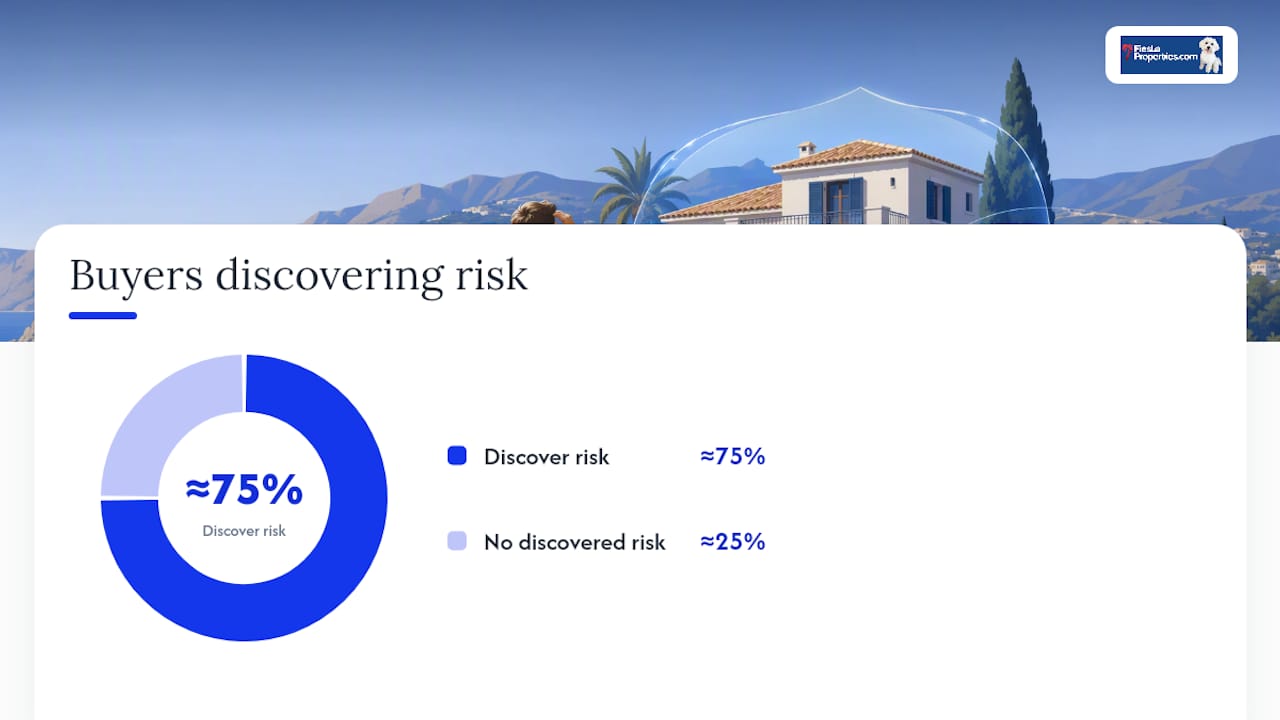
Around three in four buyers who skip a fresh Nota Simple check discover the risk only after money has changed hands. Practitioners specialising in Spanish resale transactions treat the registry extract as the single highest-value check in the entire process, precisely because it is cheap, fast, and catches problems nothing else will.
The 30-day freshness rule exists because Spanish registries update continuously, and a Nota Simple is only a snapshot. A seller struggling financially could take out a new charge against the property between your first search and completion. If your lawyer’s Nota Simple is older than a month by the time you reach the notary, insist on a fresh one rather than relying on the original.
If you do find an embargo or an undisclosed mortgage, do not panic and do not walk away automatically either. Many resale sales proceed perfectly well with an existing mortgage, provided the sale price covers the outstanding balance and the notary arranges for it to be settled and cancelled at completion. An embargo linked to a tax debt is more serious, and your lawyer should confirm in writing how and when it will be cleared before you commit to a binding contract.
Do the licences and paperwork match the physical property?
The registry confirms who owns a property. It does not confirm that the property, as it physically stands, matches what was legally built and licensed. That gap catches out a surprising number of resale buyers, particularly on properties that have been extended, had a pool added, or had a terrace enclosed at some point in their history.
Two documents matter most here. A licencia de primera ocupación (first occupation licence) or, in some regions, a cédula de habitabilidad, proves the property was signed off by the town hall as fit to live in. Without one, mortgage lenders and insurers routinely refuse cover, which turns a paperwork gap into a financing problem the moment you try to borrow against the home.
Your lawyer can also request a cédula urbanística from the town hall, which sets out the plot’s planning status and any restrictions attached to it. This is the practical way to check whether an extension, garage conversion, or extra bedroom was properly licensed, since discrepancies between the Catastro and the Registro de la Propiedad are common and should be treated as a prompt to investigate rather than proof of anything sinister on their own.
Coastal properties carry an additional layer of risk. Ley de Costas, the Spanish coastal protection law, restricts building within certain distances of the shoreline and has, in some cases, led to demolition orders on properties built without proper authorisation decades ago. If you are buying anywhere near the coast, ask your lawyer to confirm the plot’s coastal-zone status specifically, rather than assuming a clean Nota Simple covers it.
Watch for these practical red flags when viewing:
- A pool, terrace, or extra room that looks newer than the rest of the house and does not appear on the cadastral plan.
- An enclosed terrace or converted garage advertised as a bedroom.
- A seller who is vague about when an extension was built or who built it.
Pro Tip: If a property has an obvious extension, ask the seller’s agent directly whether it was licensed, and get the answer in writing before your lawyer starts formal checks. It saves time and often reveals more than the paperwork alone.
How much tax and fees should you budget for?
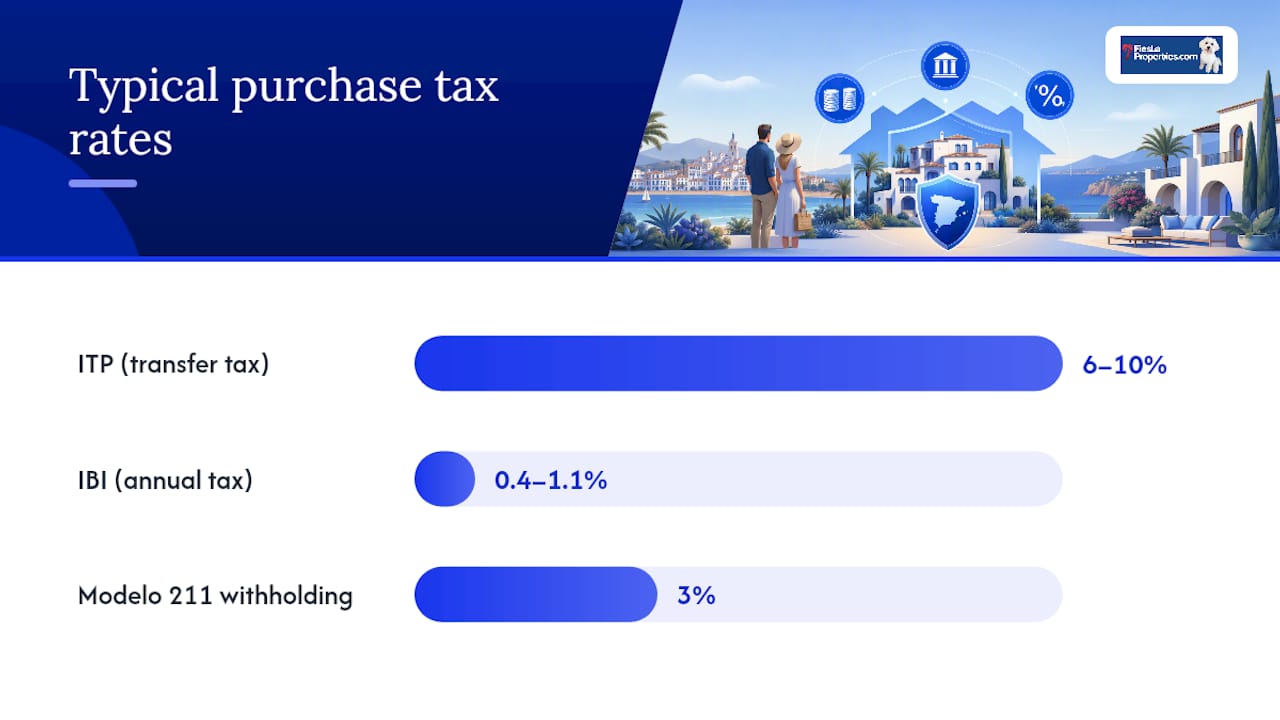
Transfer tax, known as ITP (Impuesto de Transmisiones Patrimoniales), is the main tax buyers pay on a resale purchase, and it is set by each autonomous community rather than nationally. Rates typically range from 6% to 10% of the declared purchase price, so ask your lawyer for the exact figure in the specific region you are buying in rather than relying on a generic guide, since even neighbouring regions can set different bands.
Plusvalía municipal, a local tax on the increase in land value since the last sale, is normally paid by the seller under Spanish law, though contracts occasionally shift this by agreement. Confirm in writing who is responsible before you sign anything, since a verbal understanding is worth nothing if the town hall comes looking for payment later.
Beyond ITP, expect these standard cost categories on a resale purchase:
- Notary fees, generally a few hundred pounds depending on the property value, for drawing up and witnessing the deed.
- Registration fees, paid to record the new ownership at the Registro de la Propiedad.
- Legal fees, which vary by firm and by the complexity of the checks required.
- Mortgage arrangement costs, if you are borrowing, including a bank valuation.
IBI, the annual municipal property tax, typically runs 0.4% to 1.1% of the cadastral value each year, and it is worth factoring into your ongoing budget alongside the one-off purchase taxes.
If the seller is a non-resident, remember the Modelo 211 withholding covered earlier. The buyer carries a legal obligation to withhold and pay 3% of the price to the tax authority, and failing to do so can leave you liable for the seller’s outstanding capital gains tax, even though the debt was never yours to begin with.
What will a mortgage lender want to see on a resale property?
Spanish and UK-facing lenders both require clear title and complete licensing before they will release funds, and a missing first-occupation licence or an unresolved embargo can stall an approved mortgage at the last stage. That is the scenario worth avoiding: getting excited about a property, agreeing terms, and then discovering weeks later that the paperwork is not in order.
Lenders typically distinguish between a bank valuation and a technical survey. The valuation exists purely to confirm the property is worth what the bank is lending against; it is not a structural inspection and should never be treated as one. A technical survey, commissioned separately, checks the condition of the roof, damp, electrics, and plumbing, and is the one you actually need if you want to know what you are buying.
For UK buyers specifically, expect lenders to look at:
- Loan-to-value ratios, often up to 70%, occasionally stretching to 75% with certain lenders for strong applicants.
- Residency status, since non-resident buyers sometimes face slightly different terms than Spanish tax residents.
- Proof of income and existing commitments, much as with a UK mortgage application.
- Complete legal documentation on the property itself, including the Nota Simple and licences already discussed.
Securing a mortgage approval in principle before agreeing to any binding deposit gives you a realistic sense of your budget and avoids the awkward position of committing funds you cannot actually borrow.
Should you commission a survey, and what about insurance?
A structural survey is worth commissioning on any resale property older than 15 to 20 years, and particularly on rural fincas where septic tanks, private water supplies, and unmade access roads carry their own risks that a standard valuation will never flag.
- Book the survey once your offer is accepted but before signing a private contract, so any findings can still be negotiated into the price or the terms.
- Ask the surveyor to specifically check roof condition, damp, and electrical wiring, the three issues that most commonly surface on older Spanish properties.
- Confirm the energy performance certificate is current, renewing it for £60 to £150 if it has expired, since a valid certificate is required at the point of sale.
- Arrange buildings insurance to start from the completion date, and flag any missing licences to the insurer at the quote stage rather than after a claim, since gaps in habitability paperwork can affect cover or even invalidate a policy.
Pro Tip: On a rural property, ask specifically who maintains the access road and whether the water supply is a private well or a municipal connection. Neither shows up reliably on a Nota Simple, and both can be expensive surprises after completion.
When should each check happen in a resale purchase?
- Before any offer: informal viewing, initial questions about licences and community fees.
- Before reservation or arras (deposit): independent lawyer instructed, first Nota Simple ordered, comunidad certificate and IBI receipts requested.
- Before the private purchase contract: survey completed, mortgage approval in principle secured, licences and energy certificate confirmed.
- Before notary completion: fresh Nota Simple re-ordered, all debts cleared or accounted for in the price, Modelo 211 withholding arranged if the seller is non-resident.
- At the notary: deed signed, funds transferred, keys handed over.
- After completion: registration of the new deed at the Registro de la Propiedad, typically taking several weeks.
Most resale purchases run eight to twelve weeks from accepted offer to completion, though slow registries, a delayed comunidad meeting, or an incomplete licence can extend that considerably. Building in contingency time, and making your private contract conditional on satisfactory legal checks, protects your deposit if something unexpected surfaces late.
What should you instruct your lawyer to do?
Give your lawyer clear, specific instructions rather than assuming they will second-guess what you need, since due diligence quality varies significantly between firms. Ask for:
- A fresh Nota Simple, and a second one shortly before completion.
- A certified registry certificate, if a dispute or discrepancy makes it necessary.
- A comunidad debt certificate, signed by the administrator, plus recent meeting minutes.
- Recent IBI receipts, checked against the town hall’s own records where possible.
- Confirmation of the licencia de primera ocupación or cédula de habitabilidad, and the cédula urbanística if planning history is unclear.
- Written confirmation of whether the seller is resident or non-resident, and how the Modelo 211 withholding will be handled.
Your private purchase contract should include conditional clauses that let you walk away, with your deposit protected, if any of these checks turn up an undisclosed debt or missing licence. Ask specifically about retention clauses, where part of the price is held back until a problem, such as an outstanding mortgage, is formally resolved.
If you are not fluent in Spanish, request certified translations of anything you are asked to sign, and if you cannot attend the notary appointment in person, your lawyer can arrange a power of attorney (poder notarial) so someone can sign on your behalf. Get a written cost estimate from your lawyer at the outset covering all of this, since fees can vary depending on how complex the checks turn out to be.
One point worth repeating: never simply accept the lawyer recommended by the selling agent without checking their independence. An agent’s suggested lawyer may be perfectly competent, but their fee is sometimes linked to the sale completing quickly, which is not necessarily aligned with your interest in a thorough check. A background check on any adviser, similar to the principles covered in guidance on vetting a property professional, is a sensible habit before you commit.
How Fiesta Properties supports buyers through this process
Fiesta Properties has helped buyers navigate the Costa Blanca and Costa Cálida property markets since 2010, and resale due diligence sits at the centre of how the company works with clients. The sales and aftersales side of the business is overseen by a team member experienced with common document gaps and timing pressures recurring across many transactions.
The team’s structure maps closely onto the checklist above. A mortgage specialist coordinates approval in principle so buyers know their real budget before they are anywhere near a binding deposit. A currency exchange specialist assists buyers in timing their transfers to potentially avoid costly exchange rate fluctuations. A legal specialist introduces buyers to independent legal support and helps them understand the significance of key documents like a Nota Simple and comunidad certificate.
Support often includes assisting with document requests from town halls, following up on pending certificates, and coordinating timing among surveys, valuations, and notary appointments. Independent legal advice remains essential, and buyers should always instruct their own lawyer regardless of how they were introduced to one. The service focuses on coordinating the various aspects of a resale purchase—documents, finance, currency, and timing—to work smoothly together.
Three rules I give every buyer before they sign anything
Never pay a deposit before due diligence starts. Insist every certificate is dated, not just described. Appoint a lawyer who works for you, not one suggested by the seller’s agent. I have seen a buyer lose several weeks and a fair amount of goodwill discovering, after signing arras, that a Nota Simple ordered months earlier no longer matched the property’s actual charges. A second check, costing a few euros, would have caught it before any money moved.
— Mike Kalia
Get help with your resale purchase in Spain
The company offers coordinated support for resale purchases across Costa Blanca and Costa Cálida, integrating mortgage, currency exchange, and legal specialist services, with no legal or currency exchange fees charged to clients.

If you are actively looking at resale properties, Tim can secure mortgage approval in principle before you go anywhere near a deposit, while Jamie’s currency desk helps you time a transfer sensibly rather than reactively. Carlos introduces buyers to independent legal support so the checks covered in this guide, Nota Simple, comunidad certificate, licences, actually get done properly. None of that replaces appointing your own independent lawyer, which remains essential on every resale purchase regardless of who introduces them. Browse current Costa Blanca South listings or get in touch through the main site to start a conversation about what you are looking for.
Where to go for official guidance
- Registradores’ English-language portal explains how to order a Nota Simple or certified registry certificate, and lists current fees.
- The Spanish government’s property-purchase guidance covers notarial procedure and registry checks in detail.
- Gov buying property abroad covers consular support and practical steps for UK buyers specifically.
- The FCDO’s find-a-professional service helps UK buyers locate recognised lawyers and translators in Spain.
Sources
- Buying real estate. Notarial offices and property registers – Tu espacio europeo
- Registradores — property registry guidance (English)
- Spain: buying and renting property
FAQ
What are the downsides of buying resale property in Spain from the UK?
Distance makes it harder to spot local issues like unlicensed extensions or looming community costs, and currency movements between offer and completion can change your effective budget. Working with a lawyer who communicates clearly in English, and timing your currency transfer carefully, addresses most of this.
How far back can the Spanish tax authority go on unpaid property taxes?
Spain’s general tax limitation period is four years, but debts already attached to a property, like unpaid IBI or comunidad fees, can still transfer to a new owner regardless of when the original debt arose, which is why a debt certificate matters more than the limitation period itself.
Can a Spanish debt be collected in the UK?
Under EU and UK reciprocal enforcement arrangements and standard debt recovery routes, a Spanish court judgment for an unpaid property-related debt can, in principle, be pursued against assets in the UK, though this depends on the specific debt and circumstances. It is far simpler to clear any outstanding debt before completion than to deal with cross-border enforcement afterwards.
Is it wise to buy a resale property in Spain right now?
Resale property remains a sound option for UK buyers provided due diligence is done properly. The risks worth worrying about, undisclosed debts, missing licences, unclear title, are all checkable before you commit, which makes timing far less important than the quality of your checks.
What does Fiesta Properties charge for its services?
Fiesta Properties does not charge legal fees or currency exchange fees to clients; current pricing for mortgage and property services is available directly through the Fiesta Properties site.


