

Budget 10–15% Extra: Mortgage Taxes UK Buyers Face in Spain
· 14 min read

Buying with a mortgage in Spain means paying ITP, which varies by region, generally ranging from about 6% to over 10%, depending on the autonomous community, on a resale property or IVA (10%) on a new build, plus mortgage deed stamp duty (AJD) charged at regional rates. Mortgage interest is generally not deductible for owner-occupiers at the national level since reforms in 2013, though it may be deductible against rental income. Spanish tax paid can usually be offset against UK tax through the double taxation treaty, but HMRC still expects the property and any income declared.
TL;DR:
- Non-resident buyers typically face mortgage LTVs of 60-70% and a maximum term around 25 years, with interest rates tied to the Euribor plus a margin.
- Resale properties attract ITP tax of 6-13%, while new builds pay a flat IVA rate of 10%, and all mortgage-related costs such as AJD and notary fees are separate charges.
- Mortgage interest is only tax-deductible if the property is rented out, with costs deductible proportionally for rental days, not for owner-occupiers.
- Refinance or early repayment may incur AJD taxes upon changing the mortgage, especially if legal exemptions for novation or subrogation no longer apply.
- UK buyers should prioritize obtaining an NIE, securing mortgage pre-approval, and working with specialists to navigate regional taxes, fees, and documentation requirements.
Table of Contents
- What purchase taxes apply: ITP vs IVA
- What does a mortgage actually cost in fees and taxes?
- Is mortgage interest tax-deductible in Spain?
- How does getting a mortgage in Spain work for UK buyers?
- How does Spanish tax interact with UK tax obligations?
- Budgeting for total costs: the 10–15% rule explained
- What happens if you repay your mortgage early or refinance?
- Does mortgage insurance affect your tax position?
- Do residents and non-residents pay different mortgage taxes?
- A practical checklist for UK buyers includes: get your NIE, secure mortgage pre-approval, instruct a solicitor, reserve the property, then formalise the mortgage deed and register the property. Reservation to completion typically runs eight to twelve weeks, with delays usually tracing back to slow document translation or a late-arriving apostille rather than the mortgage itself. The most common mistake is reserving a property before pre-approval is confirmed, which risks losing a deposit if the loan terms change.
- Get help with the mortgage and tax practicalities
- Where to check the official rules
- Sources
- FAQ
What purchase taxes apply: ITP vs IVA
The tax you pay depends entirely on whether the property has changed hands before. Buy an existing home, and you pay Impuesto de Transmisiones Patrimoniales (ITP), a transfer tax set by each autonomous community rather than central government. Buy a brand-new property straight from a developer, and IVA (Spain’s VAT) applies instead, charged at a flat 10% for most residential new builds.
These two taxes never overlap on the same purchase. A resale property attracts ITP alone; a new build attracts IVA alone. This matters for anyone comparing a second-hand villa in Torrevieja against a new-build apartment in Punta Prima, because the headline tax rate can look higher on paper for a new build (10% flat) while actually working out cheaper once regional ITP bands are factored in, or vice versa.
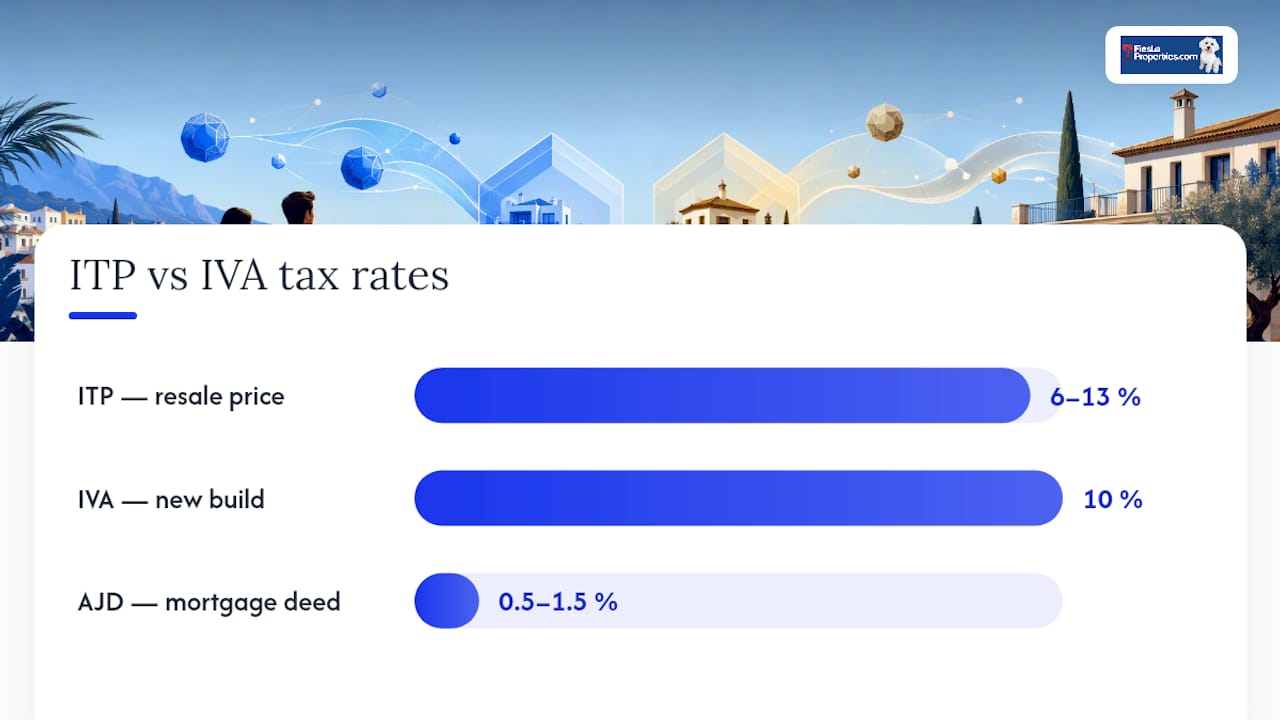
ITP rates vary more than most UK buyers expect. According to purchase cost guidance from WaypointSur, rates generally sit between 6% and 13% depending on the autonomous community, with regions such as Madrid applying rates towards the lower end and the Balearic Islands pushing towards the top for higher-value properties. The Costa Blanca and Murcia regions, where a local estate agency operates, typically sit in the middle of that range, so it pays to check the current rate for the specific community before setting a budget.
On top of ITP or IVA, every mortgaged purchase also carries Actos Jurídicos Documentados (AJD), sometimes called IAJD, a separate tax on the notarised legal document that creates the mortgage. This is charged on the mortgage liability itself, not the property price, and typically runs between 0.5% and 1.5% depending on the region, according to Bankinter’s guidance on mortgage document tax.
Broadly, a buyer needs to account for three separate charges when a mortgage is involved:
- ITP (resale) or IVA (new build) on the property price itself
- AJD/IAJD on the mortgage deed, calculated on the loan amount
- Notary and land registry fees for recording both the sale and the mortgage
Each of these is billed separately, and none of them substitutes for another. Skipping this distinction is one of the more common budgeting mistakes among first-time buyers moving from the UK, where stamp duty land tax bundles everything into one figure.
What does a mortgage actually cost in fees and taxes?
Beyond AJD, a Spanish mortgage carries several fixed costs that rarely feature in a UK buyer’s mental checklist. The valuation (tasación) is compulsory, since lenders will not proceed without an independent survey confirming the property’s worth against the loan requested. Notary fees cover the formal signing of both the purchase deed and the mortgage deed, land registry fees record your ownership and the lender’s charge against the property, and legal fees cover your own solicitor checking the contract before you commit.
Typical mortgage-related costs on a Spanish purchase
AJD/IAJD on the mortgage: 0.5–1.5% of the loan amount, depending on the autonomous community
Valuation (tasación): a fixed fee charged by the lender’s approved surveyor
Notary and registry fees: charged for both the sale deed and the mortgage deed
Source: Bankinter
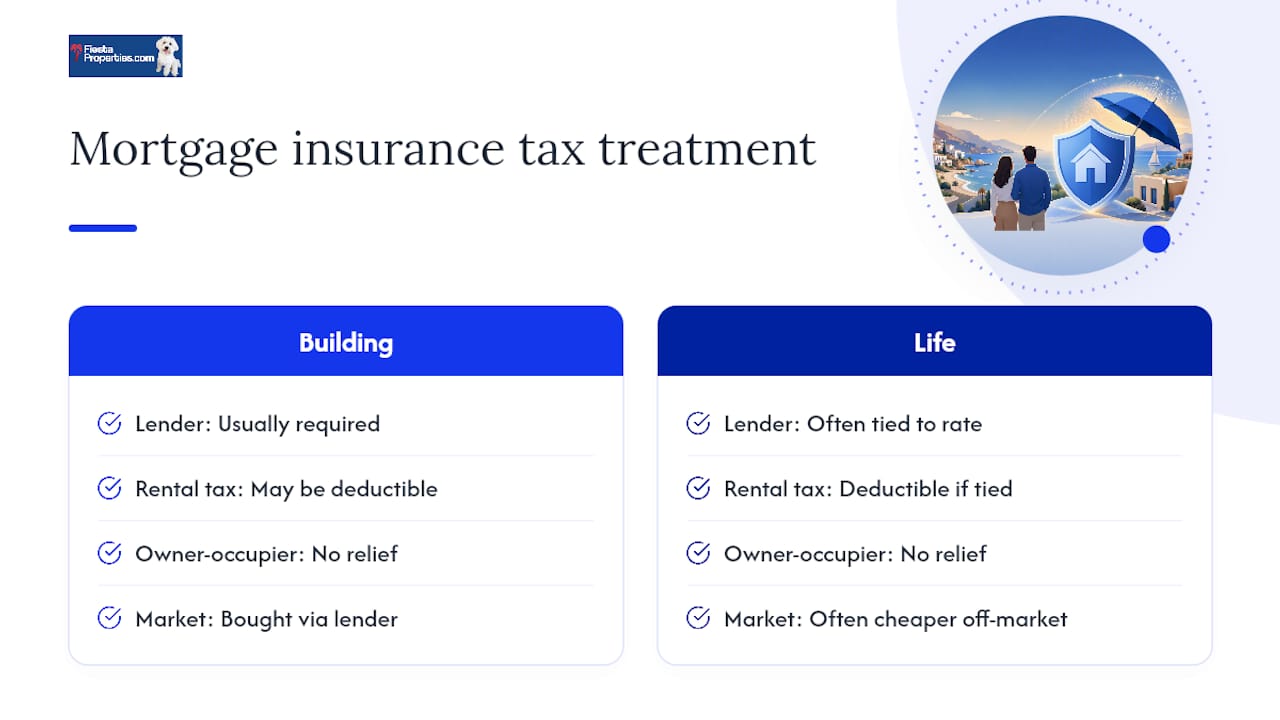
Lenders frequently make certain insurance policies a condition of approval rather than a legal requirement of the tax system itself. Building insurance is almost always compulsory when a mortgage is secured against the property; life insurance covering the loan balance is common but negotiable, and shopping around can avoid an expensive tied policy.
Who actually pays what is less clear-cut than the law suggests. Legal liability for parts of the AJD charge has shifted towards lenders in some contexts, yet market practice still often leaves valuation fees, arrangement fees, and even elements of AJD to the borrower through the loan contract terms. As one overview of the Spanish buying process puts it, foreign buyers need to check exactly which fees and insurance the lender treats as compulsory before signing, since the paperwork rarely matches assumptions carried over from a UK mortgage offer.
A short list worth confirming with any lender before signing:
- Which party is contractually responsible for AJD under this specific loan offer
- Whether life insurance and building insurance are compulsory or optional
- Whether the valuation fee is refundable if the mortgage falls through
Is mortgage interest tax-deductible in Spain?
The answer splits sharply depending on how the property is used. If you live in the property yourself, mortgage interest is not deductible at national level, full stop, for anyone who took out their mortgage from 2013 onwards. Spain scrapped the state-wide owner-occupier mortgage deduction that year, and only a shrinking pool of buyers with mortgages arranged before that cut-off retain limited transitional relief, according to analysis from EasyTaxSpain. For a UK buyer purchasing today, expecting an owner-occupier deduction similar to anything in the UK system is simply the wrong assumption to carry into the budget.
Rent the property out, and the picture changes. Spain’s tax authority confirms that interest and other financing costs are deductible against gross rental income for the period the property is actually let, as set out in Agencia Tributaria’s guidance on deductible financing costs. This covers not just interest but certain financing costs directly tied to earning that rental income.
The deduction is not automatic or blanket. It has to be apportioned:
- Only the days the property was actually rented count towards the deductible period
- Costs must correlate directly with the rental activity, not personal use
- Mandatory insurance premiums linked to the letting can also qualify
Pro Tip: Keep every mortgage statement, insurance invoice, and rental contract in one folder from day one. Spanish tax filings reward buyers who can show a clean paper trail matching rental days to financing costs claimed, and retrofitting records months later is far harder than filing them as they arrive.
How does getting a mortgage in Spain work for UK buyers?
Getting a mortgage in Spain from the UK is entirely possible, and Fiestaproperties works with buyers doing exactly this every month, but the terms differ from a UK residential mortgage in a few important ways — detailed guidance is available from James William & Co Capital | Specialist Property Finance.
- Expect a lower loan-to-value ratio. Non-resident buyers typically see LTV offers of 60–70%, according to practical mortgage guidance for foreign buyers, meaning a deposit of 30–40% of the purchase price rather than the smaller deposits some UK buyers are used to.
- Terms usually run 25–30 years, though lenders generally cap the mortgage so it ends by around age 80, which shortens the available term for older buyers.
- Rates come in two shapes. Variable-rate mortgages are typically tied to the 12-month Euribor plus a lender margin, while fixed-rate options exist but often carry a higher starting rate in exchange for certainty.
- Documentation is extensive. Lenders want your NIE (Número de Identificación de Extranjero), proof of income, bank statements, and tax returns, usually translated and apostilled before a Spanish bank will process them.
- Get an oferta vinculante (binding offer) before you reserve. This locks in the lender’s terms before you commit a reservation deposit, avoiding the position of having paid a holding deposit only to discover the mortgage terms have shifted.
Pro Tip: Currency movements between sterling and the euro can swing your effective deposit by thousands of pounds between reservation and completion. A specialist Spanish-market mortgage broker, working alongside a currency exchange specialist, can lock in rates at the right moment rather than leaving you exposed to a weak pound on completion day.
How does Spanish tax interact with UK tax obligations?
Owning a Spanish property with a UK tax residency does not mean paying tax twice on the same income. The UK and Spain operate under a double taxation treaty, which means Spanish tax paid on rental income can generally be credited against the equivalent UK tax liability, rather than both governments taking a full share.
Your Spanish tax position depends heavily on residency status. Non-residents pay IRNR (Impuesto sobre la Renta de No Residentes) on Spanish income, including rental income, at rates specific to non-residents. Spend more than 183 days in Spain in a calendar year, and you cross into Spanish tax residency, which triggers a different and generally more complex set of obligations, including worldwide income declarations in Spain itself.
For UK reporting, the property and any income from it needs declaring to HMRC through self assessment, regardless of whether Spanish tax has already been paid on it. The practical steps that keep this manageable:
- Keep copies of every Spanish tax return and payment receipt as evidence for a foreign tax credit claim
- Declare Spanish rental income on your UK self assessment return in the tax year it was received
- Claim foreign tax credit relief for Spanish tax already paid, rather than assuming HMRC will apply it automatically
Anyone with more complex circumstances, a change in residency status mid-year, high rental yields, or multiple Spanish properties, is better served consulting an international tax adviser rather than relying on generic guidance, since the interaction between the two systems gets genuinely intricate at that point.
Budgeting for total costs: the 10–15% rule explained
Most UK buyers researching Spanish property costs come across the same rule of thumb: budget an extra 10–15% on top of the purchase price to cover tax and fees. That figure is a reasonable starting point, according to WaypointSur’s breakdown of purchase costs, but it bundles together several separate charges that behave differently depending on whether you buy resale or new build.
| Cost element | Resale property (ITP route) | New build (IVA route) |
|---|---|---|
| Main purchase tax | ITP, roughly 6–13% depending on region | IVA, 10% flat |
| Mortgage deed tax | AJD, 0.5–1.5% of loan amount | AJD, 0.5–1.5% of loan amount |
| Notary, registry, legal fees | Typically 0.5–1.5% combined | Typically 0.5–1.5% combined |
Two €200,000 examples illustrate how this plays out.
What happens if you repay your mortgage early or refinance?
Repaying a Spanish mortgage early is generally straightforward, and most contracts specify an early repayment fee capped by Spanish consumer protection rules rather than left open-ended. That fee is a lender charge, not a tax, and it does not interact with the AJD you already paid when the mortgage was set up.
Refinancing is where tax exposure can resurface. Novating a mortgage, changing its terms with the same lender, or subrogating it to a new lender used to benefit from a fairly broad stamp duty exemption. Recent legal changes have narrowed that exemption considerably. According to Ashurst’s analysis of the amended stamp duty exemption, the scope of relief available for mortgage novations has tightened, which can mean AJD becomes payable again on the refinanced amount in situations that previously avoided it.
The practical takeaway for anyone considering refinancing a Spanish mortgage a few years after purchase: check the current stamp duty treatment before assuming the original exemption still applies in full. What worked for a friend’s remortgage in 2019 may not apply under today’s rules, and the difference can run into hundreds or thousands of euros depending on the outstanding loan balance. Speaking with your lender’s legal team, or an independent Spanish solicitor, before signing any novation agreement avoids an unwelcome AJD bill arriving after the fact.
Does mortgage insurance affect your tax position?
Life insurance and building insurance tied to a Spanish mortgage sit slightly outside the tax system itself, but they still shape your overall costs and, in the case of rental properties, your deductions.
Building insurance is close to universal on mortgaged properties, since lenders require proof the asset securing their loan is protected. This premium is not a tax, but if the property is let out, the premium can potentially count among the deductible financing and conservation costs against rental income, alongside the mortgage interest itself, under the same rental-period apportionment rules that apply to interest.
Life insurance covering the mortgage balance works differently. Lenders often present it as a condition of the best available rate, but it is rarely a strict legal requirement, and buyers who shop the market independently sometimes find equivalent cover for considerably less than the lender’s own tied policy. Where the policy is genuinely tied to the rental activity, for example a landlord policy required as part of letting terms, its premium may also qualify for the same rental-income deduction treatment as interest.
Owner-occupiers get no equivalent tax relief on either policy, mirroring the general position on owner-occupied mortgage interest. The insurance still protects you and the lender, but it will not reduce a tax bill if the property is your own home rather than a rental asset.
Do residents and non-residents pay different mortgage taxes?
Residency status changes far more about your tax position than most first-time buyers expect, though it changes almost nothing about the transaction taxes themselves.
ITP, IVA, and AJD apply identically to residents and non-residents at the point of purchase. Nobody gets a discount or surcharge on transfer tax or mortgage stamp duty based on where they live. The differences appear afterwards, in how any income or gains from the property get taxed.
Non-residents pay IRNR on Spanish rental income, generally at a flat rate applied to net income after allowable deductions. Residents, by contrast, declare Spanish-sourced rental income through the standard progressive income tax system used for all their worldwide income, which can work out higher or lower than the non-resident flat rate depending on total earnings.
Mortgage lending terms can also shift with residency. Non-resident buyers typically face the lower loan-to-value ceilings and shorter effective terms described earlier, while buyers who become Spanish tax residents sometimes gain access to marginally better lending terms once they can demonstrate Spanish income and a longer-standing local financial footprint. Anyone planning to relocate permanently after purchase should flag this early with a mortgage specialist, since the paperwork and terms on offer can shift meaningfully once residency status changes.
A practical checklist for UK buyers includes: get your NIE, secure mortgage pre-approval, instruct a solicitor, reserve the property, then formalise the mortgage deed and register the property. Reservation to completion typically runs eight to twelve weeks, with delays usually tracing back to slow document translation or a late-arriving apostille rather than the mortgage itself. The most common mistake is reserving a property before pre-approval is confirmed, which risks losing a deposit if the loan terms change.
— Mike Kalia
Get help with the mortgage and tax practicalities
Working through ITP bands, AJD rates, and rental deductions is manageable with the right guidance, but it helps to have specialists handling the detail while you focus on choosing the right property. There are service providers who offer UK buyers a route through the entire process with no legal fees and no currency exchange fees charged to clients, unlike routes that stack broker or conveyancing charges on top of the tax bill you’re already budgeting for.

If you’re weighing up a new build against a resale property and want to see how the tax and mortgage figures actually compare for a specific home, browse our current new build properties in Costa Blanca or get in touch for a personalised mortgage-and-tax checklist tailored to your budget and timeline.
Where to check the official rules
For anyone wanting to verify figures directly, Agencia Tributaria’s guidance on deductible financing costs covers rental deductions in detail, while Bankinter’s mortgage tax guidance sets out AJD rules by region. For UK-side obligations, HMRC’s overseas property income guidance explains what must appear on a self assessment return.
This article is general information, not a substitute for advice from a qualified financial advisor. Consult a qualified financial professional about your own circumstances before acting on anything here.
Sources
- Property purchase costs in Spain — WaypointSur guides
- Interest and other expenses for financing, conservation and repair of the property — Agencia Tributaria
- What is the tax on legal mortgage documents? — Bankinter FAQs
FAQ
Is there double taxation between the UK and Spain?
No, a double taxation treaty between the UK and Spain generally allows Spanish tax paid on rental income to be credited against the equivalent UK tax liability, rather than both countries taxing it in full.
Do I have to declare an overseas Spanish property to HMRC?
Yes, rental income from a Spanish property must be declared on your UK self assessment return, and you can claim foreign tax credit relief for Spanish tax already paid on that income.
Is mortgage interest deductible on a Spanish property?
Only against rental income; owner-occupier mortgage interest deductions at national level were removed after 2013, with limited transitional relief for a small number of pre-2013 mortgages.


