

Avoid Losing a 10% Deposit: Arras Contracts in Spain for Expats
· 13 min read

A contrato de arras is the private deposit contract that turns an accepted offer into a binding Spanish property deal. Signing one typically means handing over a deposit commonly around 10% of the price, and under Article 1454 of the Civil Code, a buyer who later walks away forfeits that deposit while a seller who backs out must repay double. Because the wording decides which rule applies, no foreign buyer should sign or transfer funds before a lawyer has reviewed the contract and the nota simple.
TL;DR:
- The deposit paid at the arras stage is usually around 10% of the purchase price, with payment methods like bank transfer and escrow accounts offering the best protection.
- The type of arras contract—penitenciales, confirmatorias, or penales—determines the consequences if either party withdraws, with penitenciales offering the most straightforward risk allocation.
- A properly drafted contract must specify the parties, property details, price, deposit, completion date, and the exact arras type to prevent costly misunderstandings.
- The legal review by an independent lawyer is essential to ensure clear wording, proper deposit handling, and effective contingency clauses, especially for mortgage and due diligence conditions.
- For resale, diligent verification of existing property status and liens is crucial, while for new builds, ensuring developer guarantees and construction timelines are key concerns.
Table of Contents
- What is an arras contract and where does it fit in the buying process?
- The three types of arras and what they mean for you
- What a properly drafted arras contract must contain
- How much deposit is normal, and how long until completion?
- What happens if either side pulls out of the deal
- How to protect yourself before you sign anything
- Your pre-signing checklist
- Do new build and resale arras contracts differ?
- Tax implications of signing an arras contract
- Why legal representation matters before you sign
- What foreign buyers consistently get wrong about arras
- How Fiestaproperties supports buyers through the arras stage
- Sources
- FAQ
What is an arras contract and where does it fit in the buying process?
An arras contract is a private preliminary agreement signed after a buyer’s offer has been accepted, but before the notarised deed (escritura pública) that formally transfers ownership. It sits in the middle of the purchase, converting a verbal or informal understanding into something with legal weight and financial consequences.
The deposit paid at this stage is deducted from the final purchase price at completion, acting as part of the price paid early to secure the property while checks and financing are finalised.
The typical sequence for buying property in Spain runs like this:
- An offer is made and accepted verbally or by email.
- The arras contract is drafted, signed, and the deposit paid.
- Due diligence, mortgage approval and NIE arrangements are completed during the agreed window.
- Completion takes place before a notary, the balance is paid, and the deed is signed.
Each stage carries its own risk, but the arras stage is where a deal becomes genuinely firm and where most disputes originate.
The three types of arras and what they mean for you
Spanish law recognises three distinct forms of arras, and the difference between them decides what happens to your money if the deal collapses. Courts tend to interpret ambiguous wording restrictively, often defaulting to the least protective category when a contract fails to state its type clearly.
Arras penitenciales (penitential deposit) give either party the right to withdraw. If the buyer pulls out, they lose the deposit outright. If the seller pulls out, Article 1454 of the Civil Code obliges them to return double the amount received. This is the most common form in residential sales precisely because the double-return penalty discourages sellers from accepting a higher offer after the fact.
Arras confirmatorias treat the deposit simply as an advance payment confirming the sale, with no right of unilateral withdrawal. If either side fails to complete, the other can sue for enforcement of the sale or claim damages through the courts rather than just keeping or losing the deposit.
Arras penales combine a binding sale with a specific penalty clause, which can sit alongside additional damages claims if the loss suffered exceeds the penalty.
| Type | Buyer withdraws | Seller withdraws |
|---|---|---|
| Penitenciales | Forfeits deposit | Returns double the deposit |
| Confirmatorias | Faces enforcement or damages claim | Faces enforcement or damages claim |
| Penales | Pays contractual penalty | Pays contractual penalty (may face further claims) |
If your contract does not say which type applies, assume the weakest protection until a lawyer confirms otherwise.
What a properly drafted arras contract must contain
A contrato de arras is only as good as its drafting, and vague wording is where foreign buyers lose money. At minimum, a properly drafted deposit contract should include the full identification of both parties, a legal description of the property referencing the Land Registry, the agreed price, the deposit amount, the completion date, and an explicit statement of which type of arras applies.
Beyond those essentials, a sensible contract also covers:
- A mortgage contingency clause protecting your deposit if finance is refused
- A commitment that the property will be delivered free of charges, debts and tenants
- A list of any fixtures, furniture or appliances included in the sale
- Clear allocation of notary, registry and agency costs between the parties
Ask where the money is actually going. A deposit held in a lawyer’s or notary’s client account is traceable and legally protected in a way that cash handed to an agent simply is not, and you should always keep a signed receipt or bank transfer confirmation as proof of payment.
Pro Tip: Never accept a contract that just says “arras” without naming the type. Ask your lawyer to insert the words “arras penitenciales, según el artículo 1454 del Código Civil” if that is genuinely what you intend, so there is no room for later reinterpretation.
How much deposit is normal, and how long until completion?
The market norm for an arras deposit sits at around 10% of the agreed purchase price, though figures between 5% and 15% are negotiable depending on the seller, the property type and local market conditions.
Payment method matters as much as the amount:
- Bank transfer leaves a clear audit trail and is the safest standard method.
- Funds held in a lawyer’s or notary’s escrow account add a further layer of protection.
- Cash payments without a documented, signed receipt should be avoided entirely.
Timelines vary with how the purchase is financed. Cash buyers can sometimes complete within a few weeks of signing the arras, while buyers relying on a mortgage should expect a completion window of 30 to 60 days to allow for valuation, approval and the paperwork tied to obtaining an NIE. Building that realistic timeframe into the contract from the start avoids the scramble of trying to extend a deadline after signing.
What happens if either side pulls out of the deal
The consequences of withdrawal depend entirely on which type of arras you signed, which is exactly why the wording matters so much before you commit any money.
- Under arras penitenciales, a buyer who withdraws simply forfeits the deposit, and the matter typically ends there. A seller who withdraws must repay double the amount under Article 1454, a deterrent commonly used to protect buyers from gazumping once a higher offer appears.
- Under arras confirmatorias, the deposit is treated as part-payment rather than a penalty. The party left waiting can go to court either to force completion of the sale or to claim damages for the loss caused by the other side’s failure to proceed.
- Under arras penales, the agreed penalty clause applies automatically, and if actual losses exceed that penalty, the injured party may still pursue an additional claim.
In every case, the strength of your position rests on how precisely the contract was drafted and how well you documented payment and communication along the way.
How to protect yourself before you sign anything
The single biggest risk in an arras contract is signing before due diligence is complete, because relying on the arras period itself to uncover problems can mean losing your deposit if something serious surfaces afterwards.
Build these protections into the contract itself:
- A mortgage contingency clause naming the lender being approached, a firm decision deadline, and a formal refusal letter as the evidence required to trigger a deposit refund.
- A condition that a fresh nota simple, showing no undisclosed charges or mortgages, is obtained before completion.
- Written confirmation that community fees are paid up to date, and that any required licences or the energy certificate will be provided.
- Explicit deposit-handling instructions naming the lawyer or notary account where funds will sit, with Article 1454 referenced if penitential arras are intended.
Pro Tip: A mortgage contingency clause is only useful if the trigger is unambiguous. Vague phrases like “if finance falls through” invite disputes. Insist on a named lender, a hard deadline, and a written refusal letter as the only acceptable proof.
Always send the draft to an independent Spanish property lawyer, and ask for a plain English translation alongside the Spanish original before you sign a word of it.
Your pre-signing checklist
Work through these steps in order, and resist any pressure to skip ahead because a seller wants a quick decision.
- Request a fresh nota simple from the Land Registry and confirm the seller’s identity matches the registered owner.
- Ask for copies of relevant licences and the energy performance certificate.
- Agree a mortgage contingency clause and completion date realistic for your finance approval and NIE application.
- Send the draft arras to your lawyer and wait for their written confirmation before transferring a single euro.
- Confirm exactly who is receiving the deposit and insist on payment into a lawyer’s or notary’s account rather than a personal or agency account.
- Keep every receipt, email and signed document in one file, in case a dispute arises later.
Do new build and resale arras contracts differ?
The legal mechanics of arras penitenciales, confirmatorias and penales apply equally whether you are buying a resale villa or reserving a unit off-plan, but the practical checks differ substantially.
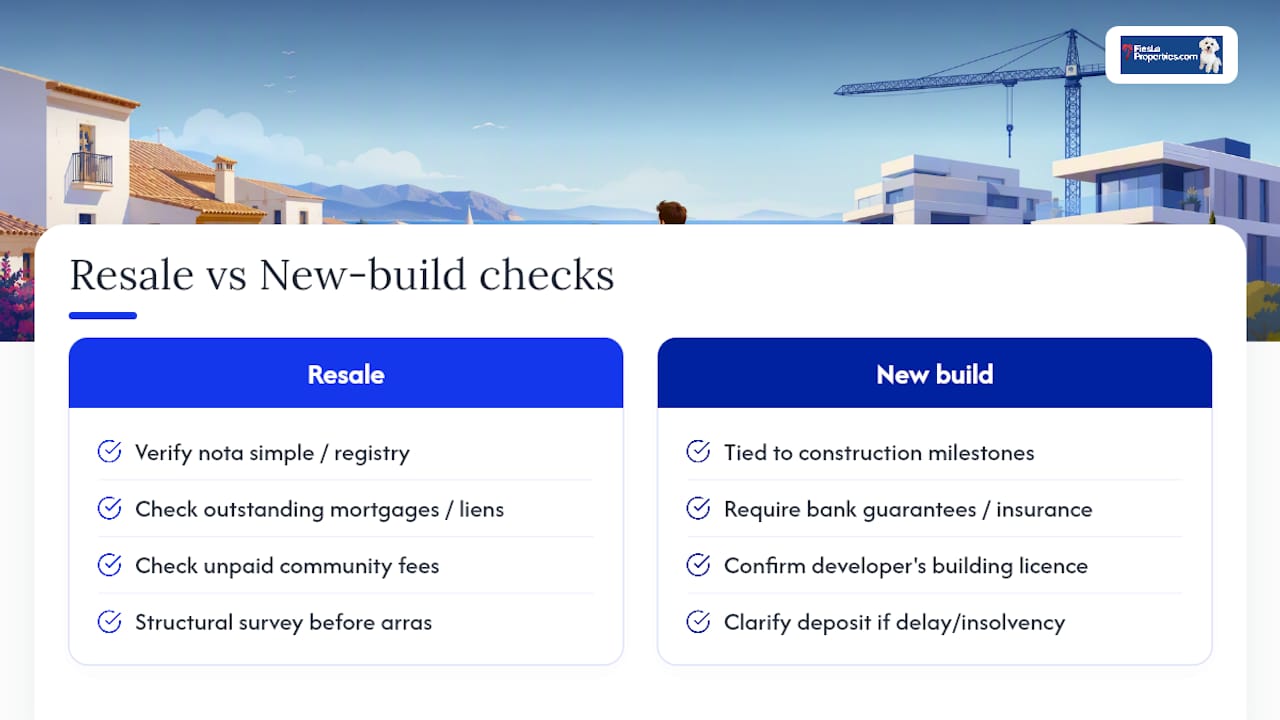
For resale property, the priority is verifying what already exists: the current nota simple, outstanding mortgages or liens, unpaid community fees, and whether the property matches its registered description. A structural survey is worth commissioning before the arras is signed, not after, since a resale arras usually moves quickly towards a notary date once due diligence is done.
For new build and off-plan property, the arras (sometimes structured as a reservation contract followed by staged payments) is tied to construction milestones rather than an existing structure. Buyers need bank guarantees or insurance covering stage payments, confirmation of the developer’s licence to build, and clarity on what happens to deposits if construction is delayed or the developer becomes insolvent. Completion dates in new build contracts are typically estimates tied to a building certificate rather than a fixed calendar date, which changes how a mortgage contingency clause should be worded.
Anyone comparing the two routes should read up on the practical differences between off-plan and key-ready purchases before deciding which suits their timeline and appetite for risk, since the protections a buyer needs at the arras stage shift depending on which route they choose.
Tax implications of signing an arras contract
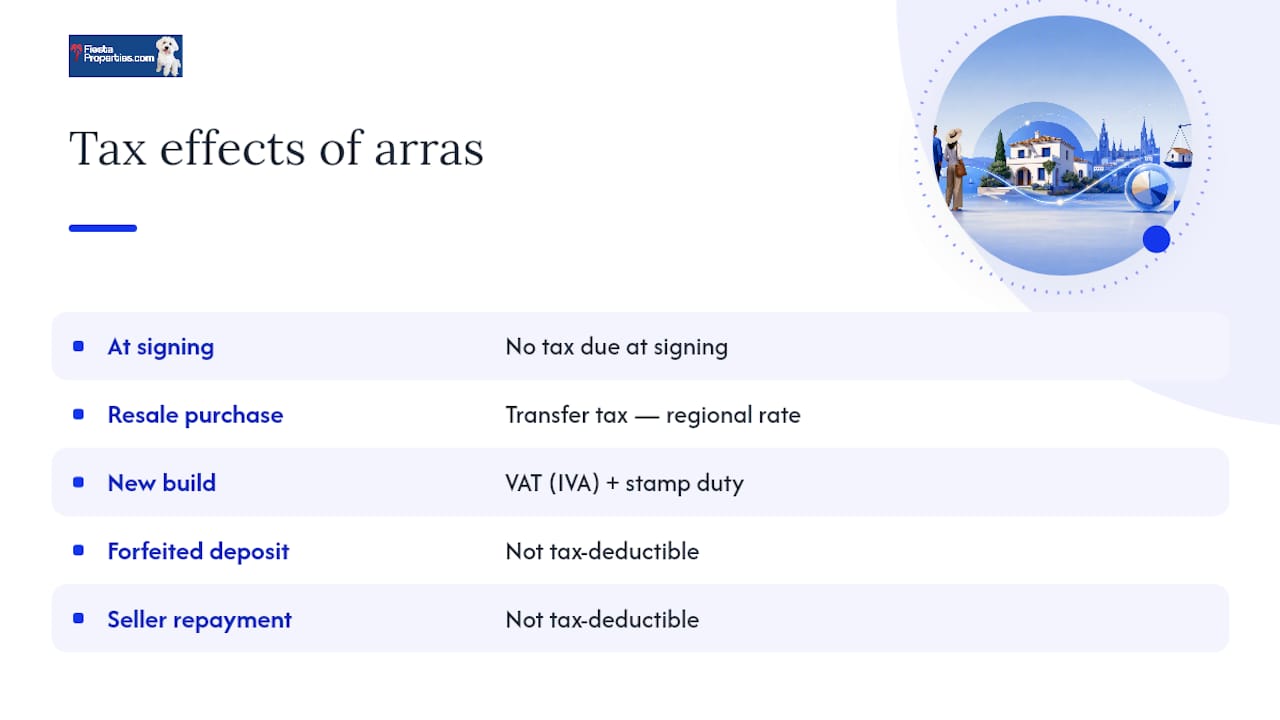
Signing an arras contract does not itself trigger a Spanish property tax bill. The deposit is a private payment between buyer and seller, deducted later from the purchase price, so no transfer tax or VAT becomes due at the point of signing.
Taxes arise at completion, and which ones apply depends on the property type. Resale purchases attract Impuesto de Transmisiones Patrimoniales, a transfer tax set regionally, while new build purchases from a developer are generally subject to VAT (IVA) plus stamp duty (Actos Jurídicos Documentados) instead. Because these figures vary by region and are set independently of the arras stage itself, buyers should confirm the exact rate applicable to their purchase with their lawyer or accountant rather than relying on a single national figure.
One point worth flagging: if a buyer forfeits their deposit under arras penitenciales, that lost sum is generally not tax-deductible as a loss, since it is treated as a private contractual matter rather than a disposal of an asset. Equally, a seller who repays double the deposit under Article 1454 is not making a deductible payment either, it is simply the contractual penalty for withdrawal. Anyone with a more complex tax position, particularly non-residents structuring a purchase through a company, should raise this with an adviser before the arras is signed rather than after.
Why legal representation matters before you sign
An arras contract looks short and simple on paper, which is exactly what makes it dangerous without proper legal review. A single ambiguous sentence can shift a deposit from penitenciales to confirmatorias, changing what happens if the deal falls through.
An independent Spanish property lawyer, one acting solely for the buyer rather than for the agent or seller, should review the draft arras before signature, check the nota simple for hidden charges, confirm the seller’s right to sell, and translate the contract in full so nothing is agreed on trust. This is standard practice recommended across legal guides to Spanish deposit contracts, and it costs a fraction of what a poorly worded clause can cost if the deal turns sour.
Legal representation also matters for practical coordination: liaising with the notary, confirming mortgage contingency wording matches your actual lender’s process, and holding the deposit in a client account rather than letting it pass through informal channels. None of this replaces your own judgement, but it removes the single biggest source of risk in a Spanish purchase, signing something you did not fully understand.
What foreign buyers consistently get wrong about arras
Most disputes over an arras contract in Spain do not stem from bad faith. They stem from buyers treating the reservation stage as a formality rather than the point at which real financial risk begins. The pattern repeats: a buyer falls for a property, feels pressure to secure it quickly, and signs a short contract drafted by the selling agent without independent review.
The mortgage contingency clause is where I see the most damage done. Buyers assume that if their mortgage falls through, they simply walk away and get their deposit back. Without a precisely worded clause naming the lender, the deadline and the required refusal letter, that assumption can cost thousands. Ambiguous wording almost always favours whoever drafted the contract, which is rarely the buyer.
Coordinated legal checks solve most of this before it becomes a problem: a fresh nota simple, a mortgage clause tied to a genuine lender decision, and deposit funds sitting in a traceable account rather than a personal one. When buyers get organised support across those three points early, the arras stage stops being a source of anxiety and becomes exactly what it should be, a straightforward step towards completion.
— Mike Kalia
How Fiestaproperties supports buyers through the arras stage
Reviewing an arras contract properly means checking legal wording, financing terms and the property’s registered status all at once, which is exactly where a coordinated team earns its keep. Fiestaproperties brings together the people you need at this stage under one roof: Carlos, our legal specialist, coordinates with your own independent lawyer on nota simple checks and contract wording; Tim, our mortgage specialist, structures a realistic contingency clause around fixed rates from 2.4% and terms up to 30 years; and Jamie manages currency exchange so your deposit transfer arrives at the best available rate. None of this carries legal or currency exchange fees.

If you have been sent a draft arras contract and want a second set of eyes before you sign, get in touch through our property search platform to book a consultation, or browse current new build listings across Costa Blanca while your legal and mortgage checks are underway. Fiestaproperties works alongside your independent lawyer, not instead of one, giving you a practical second layer of support through what is usually the most stressful stage of buying in Spain.
Sources
For readers who want to verify specific legal or procedural points, the Notariado and Registradores websites provide official information on notarial procedure and Land Registry checks respectively. Legal commentary on Article 1454 and arras types is available through specialist Spanish property law firms, and practical buyer guides cover deposit amounts, mortgage clauses and completion timelines in more detail.
This article is general information, not a substitute for advice from a qualified lawyer. Consult a qualified legal professional about your own circumstances before acting on anything here.
- What is an arras contract and what is it for | Bankinter
- Arras Contract Spain: Types & Legal Interpretation | Agave Abogados
- The arras contract explained | Barleigh Ellis
FAQ
What does the Spanish word “arras” mean?
“Arras” translates roughly as “earnest money” or “pledge”, referring to the deposit paid to secure a property purchase before the final notarised deed is signed.
What is the legal definition of an arras contract?
An arras contract is a private preliminary agreement in which a buyer pays a deposit, deducted from the final price, to reserve a property, with Article 1454 of the Civil Code governing the penitential form most commonly used.
What are my rights as a tenant in Spain after 5 years?
This falls under separate tenancy legislation rather than the arras deposit contract, since arras applies specifically to purchase transactions, not rental agreements; tenants should consult Spain’s Urban Leasing Law (LAU) for rights tied to contract renewal periods.
What are the current rules for buying property in Spain as a foreigner?
Foreign buyers need an NIE (foreigner identification number) to purchase, must complete due diligence including a nota simple check, and typically move through offer, arras contract, and notarised completion, with no restriction on EU or non-EU buyers acquiring residential property.
How much deposit is typical under an arras contract?
The market norm is around 10% of the agreed purchase price, though 5% to 15% is negotiable depending on the property and the seller’s position.


